
From Philosophical Letters to Digital Peer Review: The History of Academic Journals
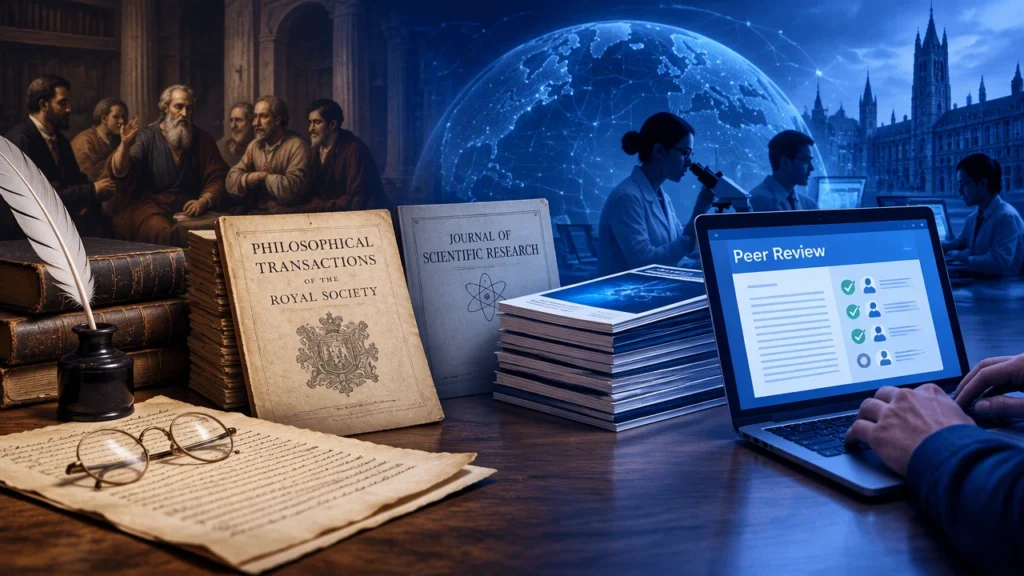
The history of academic journals and peer review is a story about how knowledge moves from private curiosity to public record. Long before searchable databases, researchers exchanged findings through letters, manuscripts, and conversations in learned societies. Over centuries, those informal channels developed into journals, editorial standards, peer review, and digital platforms that now shape how science is communicated, evaluated, and preserved.
For readers interested in nauka i badania, this evolution reveals more than publishing trends. It shows how scholarly communities decide what counts as reliable knowledge, how they manage disagreement, and how they balance speed with careful verification.
Before journals: letters, academies, and the republic of learning
In early modern Europe, scholars often shared discoveries through correspondence. A philosopher might send a letter describing an astronomical observation, a medical case, or a mathematical proof. These letters were practical: they could travel across borders, introduce a new idea, and invite comment from trusted correspondents. Yet they were also limited. Access depended on personal networks, copies could be altered, and there was no stable way to organize a growing body of findings.
Universities and courts supported learned conversations, but print culture gradually changed the scale of exchange. The printing press made it possible to reproduce texts accurately and distribute them beyond a single city. Still, printed books were slow to produce and expensive. Scholars needed a lighter format for reporting results as they emerged.
That need helped inspire periodical publication. In the seventeenth century, journals began to gather reports of experiments, observations, and arguments in a regular sequence. Early titles such as the Journal des sçavans and the Philosophical Transactions of the Royal Society offered readers a curated view of what was happening across European scholarship. They did not look like modern journals, but they established an important principle: research could be presented as a continuing public conversation rather than as a solitary book.
The journal becomes an institution
As journals spread, editors and learned societies developed practices that gave the format authority. Articles became shorter and more focused than treatises. Writers identified methods, reported results, and distinguished observation from speculation. Journals also created regularity: readers knew when to expect a new issue, and contributors could point to a dated record of their work.
This institutionalization changed the status of publication. Appearing in a respected journal did more than share information; it signaled that a work had entered a recognized scholarly space. Libraries collected issues, researchers cited earlier contributions, and editors built reputations through careful selection. The journal became both a communication tool and a marker of credibility.
Over time, disciplines developed their own publishing cultures. Mathematics prized concise proofs and clear notation. Experimental sciences emphasized procedures, instruments, and reproducibility. Humanities journals made room for extended interpretation and debate. These differences reflected deeper questions about what evidence looks like and how knowledge should be argued.
Peer review: evaluating work before the wider audience
Peer review did not appear all at once. In its earliest forms, editors consulted trusted experts before deciding whether to print a submission. The process was informal, uneven, and often private. As research became more specialized, editors could no longer judge every paper alone. They needed readers who understood the technical details of a method, a source base, or a statistical claim.
By the twentieth century, many journals had adopted more structured review systems. A manuscript would be read by one or more external specialists who assessed its originality, methods, clarity, and significance. Their comments could lead to acceptance, revision, or rejection. The aim was not to guarantee that every conclusion was correct. It was to reduce obvious errors, test the strength of the reasoning, and help editors make responsible decisions.
Peer review is often described as a gatekeeping system, but it also functions as a form of scholarly service. Reviewers contribute time and expertise to maintain a shared standard. Authors receive feedback that may improve the work even when the paper is not accepted. The process is imperfect: it can be slow, biased, or overly conservative. Nevertheless, it remains one of the main mechanisms for screening research before it reaches a broad audience.
Digital platforms and the changing rhythm of publication
The move from print to digital publishing altered nearly every part of the process. Online journals could publish continuously rather than waiting for quarterly issues. Search engines and databases made articles discoverable across institutions and languages. Reference managers simplified citation, while open-access models expanded readership beyond subscribers.
Digital tools also created new pressures. The volume of submissions increased, and editors faced rising demands for speed. Preprint servers allowed researchers to circulate findings before formal review, accelerating conversation but also making clear the difference between preliminary reports and fully evaluated publications. Automated screening, plagiarism detection, and data-availability policies became part of the editorial workflow.
At the same time, digital platforms raised questions about permanence. Links can break, platforms can change, and file formats can become obsolete. Libraries and publishers therefore invest in preservation, metadata, and long-term access. A journal article is not only a text; it is a record that must remain usable for future readers.
What the evolution teaches us
The path from philosophical letters to modern peer-reviewed platforms shows that scholarly publishing is a social technology. It organizes trust, attention, and memory. Each stage added a new layer: print created repeatability, journals created continuity, peer review created screening, and digital systems created scale.
Understanding this history helps readers evaluate today’s debates about open science, artificial intelligence in review, and the metrics used to rank research. None of these developments stands alone. They build on older questions about who may speak, what evidence counts, and how a community corrects itself.
The future of academic publishing will likely continue this pattern of adaptation. New tools will change the speed and reach of communication, but the underlying task remains familiar: to turn individual inquiry into knowledge that others can inspect, challenge, and extend. The history of academic journals and peer review reminds us that reliable scholarship is not produced in isolation. It is sustained by institutions, practices, and people who treat publication as a shared responsibility.