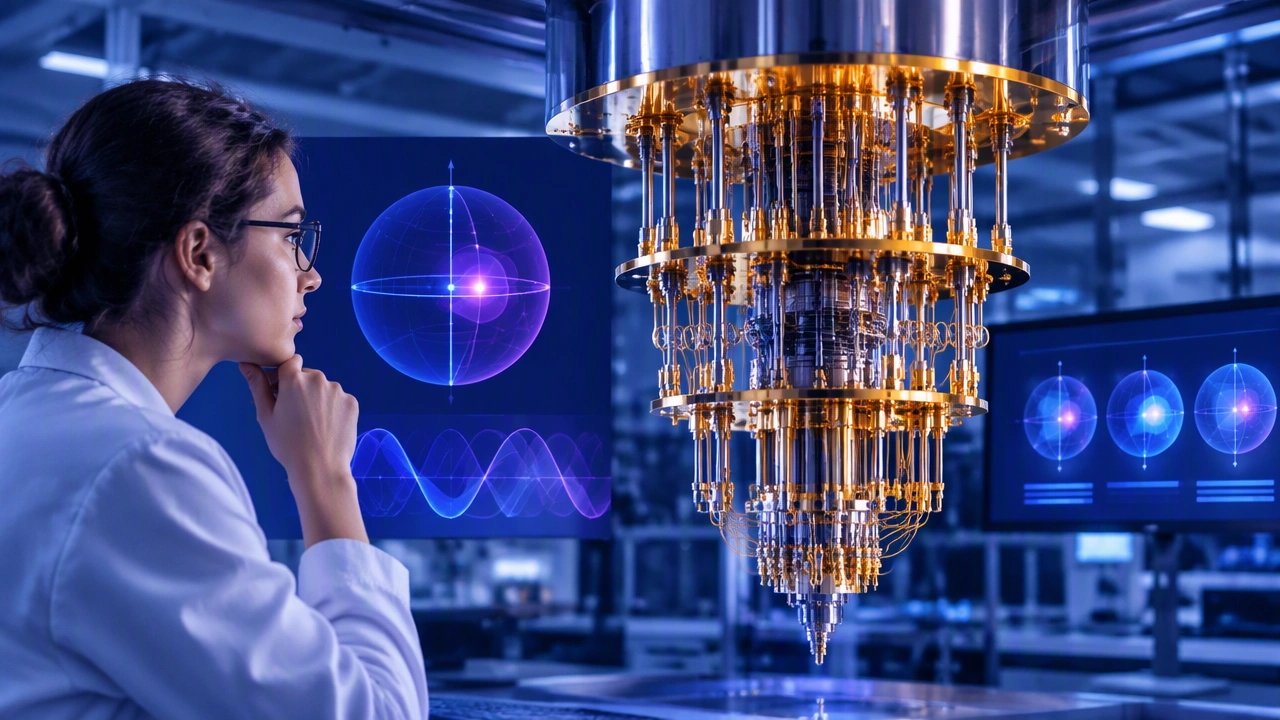
Quantum Computing Explained for Beginners: How Qubits and Superposition Will Revolutionize Science
In the broader landscape of nauka i badania (science and research), few emerging technologies have generated as much excitement and confusion as quantum computing. For decades, it existed mostly in physics journals and theoretical papers. Today, it is rapidly becoming a practical tool that could transform fields from drug discovery to climate modeling. This article offers a grounded, beginner-friendly overview of what quantum computing actually is, how it differs from classical computing, and why researchers around the world consider it a potential revolution.
What Is Quantum Computing?
At its core, quantum computing is a fundamentally different way of processing information. Classical computers — the laptops, phones, and servers we use every day — store and manipulate data using bits, which exist in one of two states: 0 or 1. Every task your computer performs, from loading a webpage to rendering a video, ultimately reduces to operations on long strings of these binary digits.
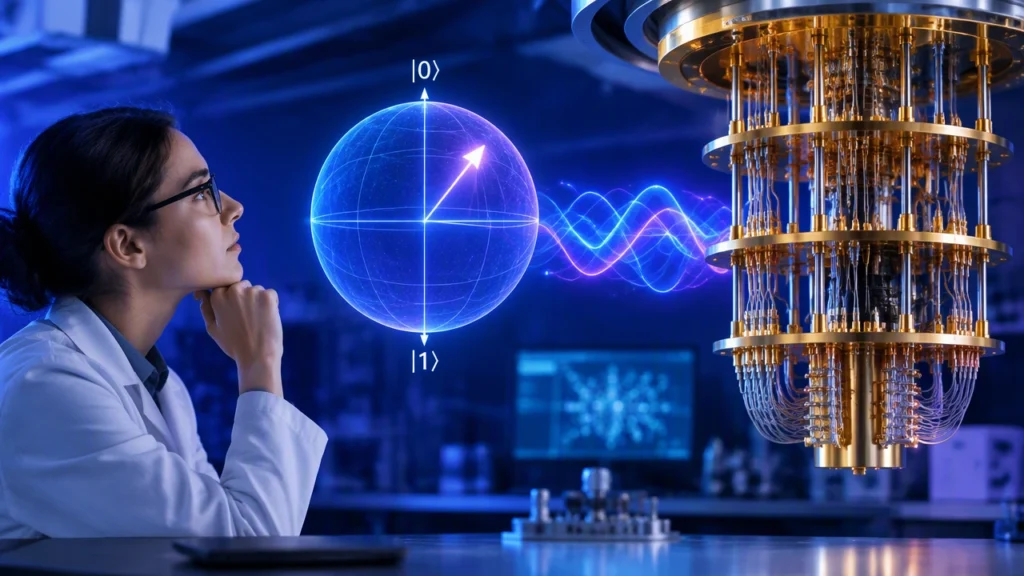
Quantum computers use a different unit of information called a qubit (quantum bit). Unlike a classical bit, a qubit can exist in a state that is not simply 0 or 1, but a combination of both simultaneously. This property, rooted in the principles of quantum mechanics, is what gives quantum computers their extraordinary potential.
Understanding Qubits
A qubit is the basic building block of quantum information, just as a bit is the building block of classical information. Physically, qubits can be realized in several ways: trapped ions, superconducting circuits, photonic systems, or even the spin of an electron. Despite these different implementations, they all share the same defining quantum properties.
The key distinction is that a classical bit is like a light switch — it is either on or off. A qubit, by contrast, is more like a dimmer switch that can be on, off, or any combination in between, until it is measured. This is not a matter of imprecision or engineering limitation; it is a fundamental feature of quantum physics. When a qubit is measured, it collapses into one definite state (0 or 1), but before measurement, it holds a richer set of possibilities.
Superposition: Being in Two States at Once
Superposition is the principle that allows a qubit to exist in a combination of 0 and 1 simultaneously. Think of a spinning coin. While it is spinning, it is neither heads nor tails — it is effectively both. Only when it lands (when you measure it) does it settle into one outcome.
In practical terms, superposition means that a quantum computer with n qubits can represent 2n states at the same time. A system of just 300 qubits could, in principle, represent more states than there are atoms in the observable universe. This exponential scaling is the source of quantum computing’s power and the reason it cannot simply be replicated by making classical computers faster.
Entanglement: The Quantum Connection
Superposition alone is not the whole story. Entanglement is a second quantum phenomenon that is essential to quantum computing. When two qubits become entangled, the state of one is directly correlated with the state of the other, no matter how far apart they are. Measuring one instantly tells you something about the other.
Entanglement allows quantum computers to coordinate computations across many qubits in ways that have no classical equivalent. It is this combination of superposition and entanglement that enables quantum algorithms to explore vast solution spaces simultaneously, finding answers to certain problems far more efficiently than any classical machine could.
Why Quantum Computing Could Revolutionize Science
The scientific community is not interested in quantum computing simply because it is novel. The motivation is practical: there are important problems that classical computers cannot solve in any reasonable amount of time.
- Drug discovery and molecular simulation: Understanding how molecules behave requires simulating quantum interactions. Classical computers struggle with this because molecular complexity grows exponentially. Quantum computers are naturally suited to simulate quantum systems, potentially accelerating the development of new medicines and materials.
- Climate and weather modeling: Accurate climate predictions involve solving enormously complex systems of equations. Quantum algorithms could improve the precision and speed of these models, leading to better environmental policy decisions.
- Optimization problems: Many challenges in logistics, finance, and engineering reduce to finding the best solution among a vast number of possibilities. Quantum computing offers promising approaches to these optimization tasks.
- Cryptography and security: Quantum computers could break certain encryption methods that protect digital communication today. This threat is driving research into new, quantum-resistant cryptographic standards.
Current State and Honest Limitations
It is important to approach quantum computing with realistic expectations. As of now, quantum computers are not general-purpose replacements for classical machines. They are specialized tools that excel at certain types of problems. Current systems are noisy, meaning qubits are fragile and prone to errors caused by environmental interference. Building a large-scale, fault-tolerant quantum computer remains one of the greatest engineering challenges of our time.
Major technology companies and research institutions — including IBM, Google, and various universities — are actively working to increase the number and quality of qubits. Recent milestones, such as demonstrations of quantum advantage on specific tasks, show real progress, but a fully practical, error-corrected quantum computer is likely still years away.
Why Beginners Should Pay Attention
Quantum computing explained for beginners is not about mastering the mathematics of Hilbert spaces or tensor products. It is about understanding a shift in how we think about computation itself. The transition from classical to quantum computing parallels earlier transitions in science — from Newtonian mechanics to relativity, for example — where the old framework was not wrong, but incomplete.
For students, educators, and anyone engaged in science and research, developing a basic literacy in quantum concepts is increasingly valuable. As quantum hardware matures, the demand for professionals who understand both the science and its applications will grow significantly.
Looking Ahead
Quantum computing is not science fiction. It is an active, rapidly advancing field with real investment, real hardware, and real (if currently limited) results. Its promise lies not in replacing classical computers but in solving problems that were previously considered intractable. For the world of science and research, this represents one of the most significant technological opportunities of the coming decades. Understanding the basics today — qubits, superposition, and entanglement — is the first step toward engaging with a technology that may reshape how we understand and interact with the natural world.