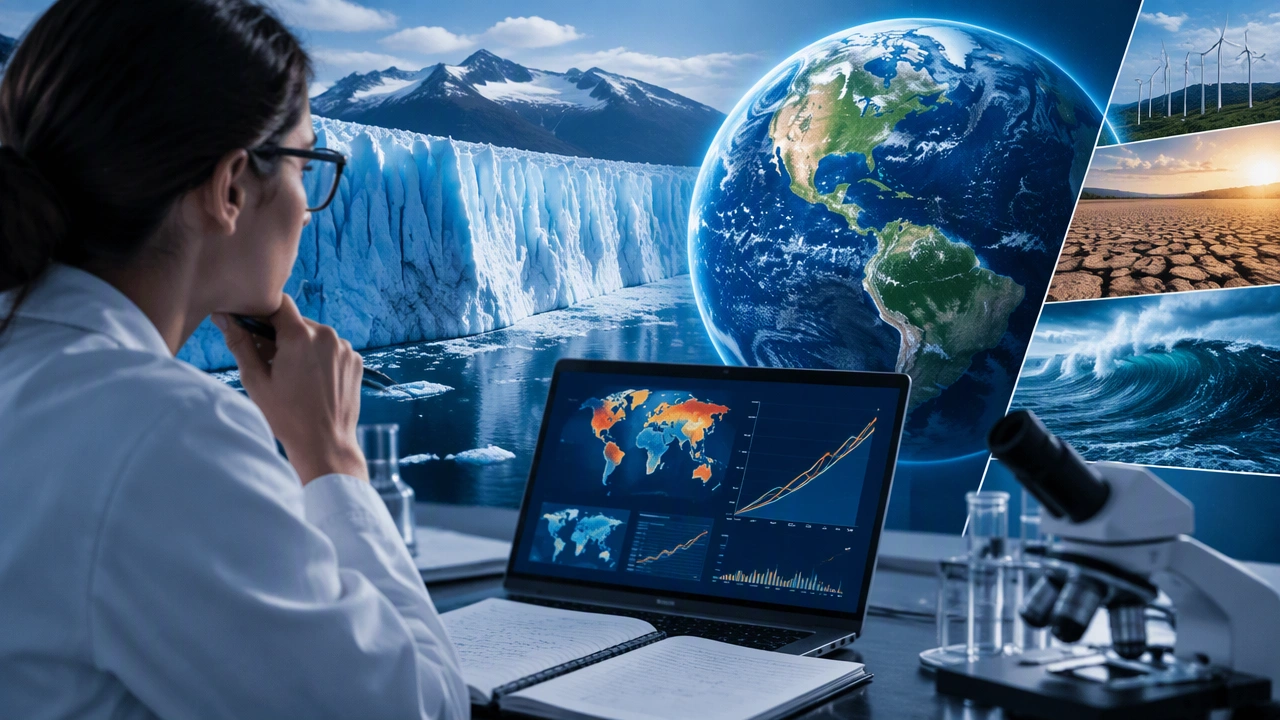
Latest Climate Change Research Findings Explained: What Science Reveals About Our Planet’s Future
In nauka i badania, climate research has moved from broad warnings to precise diagnostics. The latest synthesis from the Intergovernmental Panel on Climate Change, along with annual global analyses from NASA, NOAA, and independent research groups, converges on a clear picture: human activities, primarily the burning of coal, oil, and gas, are driving rapid warming, intensifying extremes, and reshaping natural and human systems. The latest climate change research findings explained here focus on what has been observed, what models project, and what those results imply for the future of our planet.
Observed Changes and Their Causes
Multiple independent datasets show that the planet has warmed by roughly 1.1–1.3 degrees Celsius above preindustrial levels, depending on the baseline and dataset. The last decade is the warmest on record, with ocean heat content reaching unprecedented levels. Because oceans absorb over 90 percent of the excess heat, marine heatwaves have become more frequent and intense, stressing coral reefs, fisheries, and coastal communities.
Attribution science, which uses observations and models to quantify human influence, now regularly finds that many extreme events are made more likely or more severe by climate change. Heatwaves, heavy rainfall events, and some droughts show clear human fingerprints. While natural variability still drives year-to-year fluctuations, the long-term trend is dominated by greenhouse gas emissions. This is not a projection; it is a measured reality confirmed across surface stations, satellites, ocean buoys, and reanalysis products.
What Models Tell Us About the Future
Climate models are not crystal balls, but they are powerful tools for exploring how the climate system responds to different emissions pathways. Under low-emission scenarios aligned with deep decarbonization, models project warming that peaks later this century and gradually stabilizes. Under high-emission scenarios, warming continues, with global temperatures potentially exceeding two or three degrees Celsius by 2100, depending on the pathway.
Models also capture important regional differences. Arctic regions warm faster than the global average, monsoon patterns can shift, and drought-prone areas may face longer dry spells. Importantly, models are evaluated against historical observations, and their large-scale projections have proven broadly consistent with observed trends. Uncertainties remain, especially for regional details and the behavior of clouds, but the overall direction and risks are robust.
Sea-Level Rise and Cryosphere Changes
Sea-level rise is accelerating. Research shows the current global rate is several millimeters per year, driven by thermal expansion of seawater and the loss of land ice from glaciers and the Greenland and Antarctic ice sheets. Satellite altimetry and tide gauges provide consistent evidence of this acceleration. Coastal communities are already experiencing higher high-tide flooding, stronger storm surges, and chronic erosion.
The cryosphere, the frozen parts of the Earth system, is also changing rapidly. Mountain glaciers are retreating, Arctic sea ice extent continues to decline in summer, and permafrost thaw is affecting infrastructure and releasing greenhouse gases. While the exact timing and magnitude of potential ice-sheet tipping points remain active research questions, the risk of committing the world to meters of eventual sea-level rise over coming centuries is a central concern in the latest assessments.
Tipping Points, Feedbacks, and Risks
A major focus of recent research is the potential for tipping points, thresholds beyond which changes become self-reinforcing or very difficult to reverse. Examples include the dieback of parts of the Amazon rainforest, destabilization of parts of the West Antarctic or Greenland ice sheets, and widespread permafrost thaw. Evidence suggests that some of these risks increase with higher warming levels, and that the probability of crossing multiple thresholds grows as global temperatures rise.
Feedbacks amplify these risks. A warmer atmosphere holds more moisture and energy, fueling heavier rainfall and stronger storms. Thawing permafrost releases carbon dioxide and methane, which can enhance warming. Loss of ice reduces the planet’s reflectivity, causing additional heat absorption. These mechanisms are now better represented in models, which is why risk curves often steepen above one and a half degrees of warming.
Impacts on Ecosystems, Health, and Food Systems
Climate change is already affecting biodiversity, food production, and human health. Heat stress reduces labor productivity and increases mortality during extreme heat events. Shifting rainfall and temperature patterns alter crop yields and water availability. Disease vectors such as mosquitoes expand into new regions as conditions warm. Ecosystems face compound pressures from heat, drought, fire, and land-use change, leading to habitat loss and species range shifts.
These impacts are uneven. Communities with fewer resources to adapt, small island states, and regions dependent on rain-fed agriculture face higher risks. Research underscores that climate action is also a matter of equity, health, and economic stability, not just environmental protection.
What the Evidence Suggests About Pathways Forward
The same body of research that documents risks also points to practical solutions. Rapid cuts in greenhouse gas emissions, especially carbon dioxide and methane, can slow the rate of warming and reduce near-term risks. Energy efficiency, renewable power, grid modernization, and electrification of transport and industry are central. Methane reductions from oil and gas operations, agriculture, and waste offer fast climate benefits because methane is potent but short-lived.
Carbon dioxide removal is likely needed to balance residual emissions and, in some scenarios, to lower temperatures after a peak. Approaches range from nature-based solutions, such as reforestation and soil carbon management, to engineered methods like direct air capture. Research emphasizes that removal must complement, not replace, deep emissions cuts. Adaptation is equally essential: early warning systems, climate-resilient infrastructure, water management, and protective ecosystems such as mangroves and wetlands help communities manage unavoidable changes.
How to Interpret Uncertainty
Uncertainty in climate science is often misunderstood. It does not mean that findings are unreliable. Instead, it reflects ranges of possible outcomes and remaining questions about specific processes or regional details. The core conclusions, including that human-caused warming is occurring, that risks rise with higher temperatures, and that emissions choices shape future outcomes, are supported by strong evidence. Policymakers use these ranges to plan for a spectrum of possibilities, prioritizing actions that reduce risk across scenarios.
Why These Findings Matter Now
Climate research provides a map of risks and options. It shows that the future is not fixed: the choices societies make this decade will influence the climate for centuries. Cutting emissions, preparing for unavoidable changes, and investing in innovation and resilience can reduce harm and unlock benefits in health, energy security, and economic opportunity.
For readers seeking a concise takeaway from the latest climate change research findings explained in the scientific literature, the message is consistent and actionable. The planet is warming, extremes are intensifying, and the risks of crossing critical thresholds grow with delay. At the same time, effective tools exist today to reduce emissions and build resilience. Continued research, transparent communication, and steady implementation are the bridges between knowledge and a safer, more sustainable future.